Field Manual · First Edition · 2026

Every preparedness guide stops at three days. The disaster doesn't.

Forty-five chapters covering every hazard that can reach your address — earthquake, flood, tsunami, hurricane, tornado, volcano, wildfire, heat and cold — then the first seventy-two hours, then the six months that decide whether your household actually recovers. Every figure sourced to a named agency.

Launch price ends in10hrs10min02sec
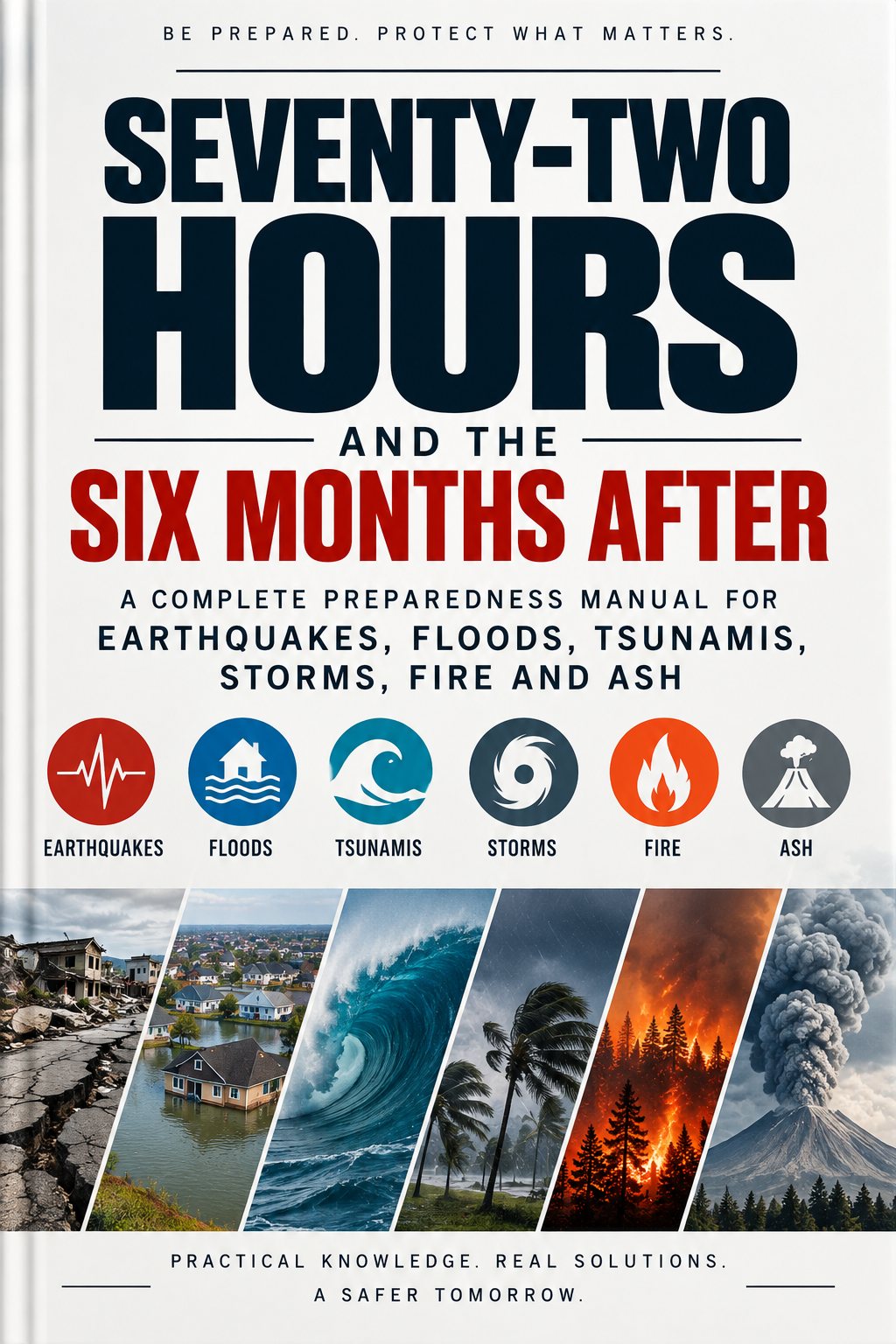
72 Hours and the 6 Months After — a complete preparedness manual for earthquakes, floods, tsunamis, storms, fire and ash
422 pages · 45 chapters · Illustrated PDF
45chapters, in nine sections
422pages, illustrated throughout
9hazards, each covered in full
6printable companion documents

Not a book about bunkers and buckets. A book about the two weeks your household has to get through alone.

Why this one is different

Six things no other preparedness guide does.

Most of what is sold in this category is a checklist with a stock photo on the front. Here is what separates this from that.

One

Every hazard, not the famous one

Earthquake, tsunami, flood, hurricane, tornado, volcano, ashfall, wildfire, extreme heat and extreme cold. Nine hazard families, each with its own chapters on what it does, what to do before, and what to do while it happens.

Two

It starts by telling you which chapters are yours

Section One is an afternoon with four free federal map layers. You come out with a written, ranked list of the hazards that can actually reach your address — and that list decides everything you buy afterwards.

Three

It keeps going after day three

Nine chapters on the part nobody writes about: documenting damage so the claim pays, mould and structure, what public assistance actually covers, and the week-two problems that are not about food.

Four

Every number names its source, in the text

USGS, NOAA, FEMA, CDC, EPA, CPSC, SBA, the NFIP, the BC Coroners Service, the Oregon Resilience Plan — with the web address printed beside the figure so you can check any of it yourself.

Five

Every chapter ends with what it cannot do

Forty-five honest-limit boxes naming exactly where a method stops working and when to call a professional. No guide that is trying to sell you something writes those.

Six

Built to be used, not read

Forty-five artifacts — checklists, decision trees, scripts and worksheets — set in boxes you can photograph. Plus six printable documents for the moments when the book is not in your hand.

Illustrated PDF · 422 pages · 9 sections · 45 chapters · 45 photographs · 20 charts · 6 companion documents

The four free map layers that tell you which disasters can reach your address. The forty-minute house survey, room by room, that finds what will hurt you. Water, food, power, warmth and sanitation, in the order they fail. Three kits, not one, and why a single bag cannot do both jobs. What actually kills people in earthquakes, which is almost never the shaking. The six inches of moving water that takes an adult off their feet, and the twelve that carries a car.

The three different floods that need three different plans. Why the hurricane warning arrives after your real decision deadline. Thirteen minutes, and the interior room that will do. The ember, not the flame, and the first five feet around your house. Volcanic ash, which is not snow and weighs far more than it looks. The two extremes that quietly kill more people than all of them. The first fifteen minutes, in order. And then the claim, the mould, the money and the month.

Regular price $47 · Launch edition $27 · Six companion documents ($106) included free

The arithmetic

What help actually pays, and what you carry.

People assume that after a declared disaster, someone makes them whole. The published figures say otherwise, and the gap between the two numbers below is the reason this book exists.

What a household typically receives

$1,000

Median FEMA Individuals and Households Program award for non-wildfire disasters, 2013–2023. The median wildfire award is $3,150.

What the programme caps at

$43,600

The maximum for housing assistance, for disasters declared on or after 1 October 2024 — a ceiling almost nobody reaches.

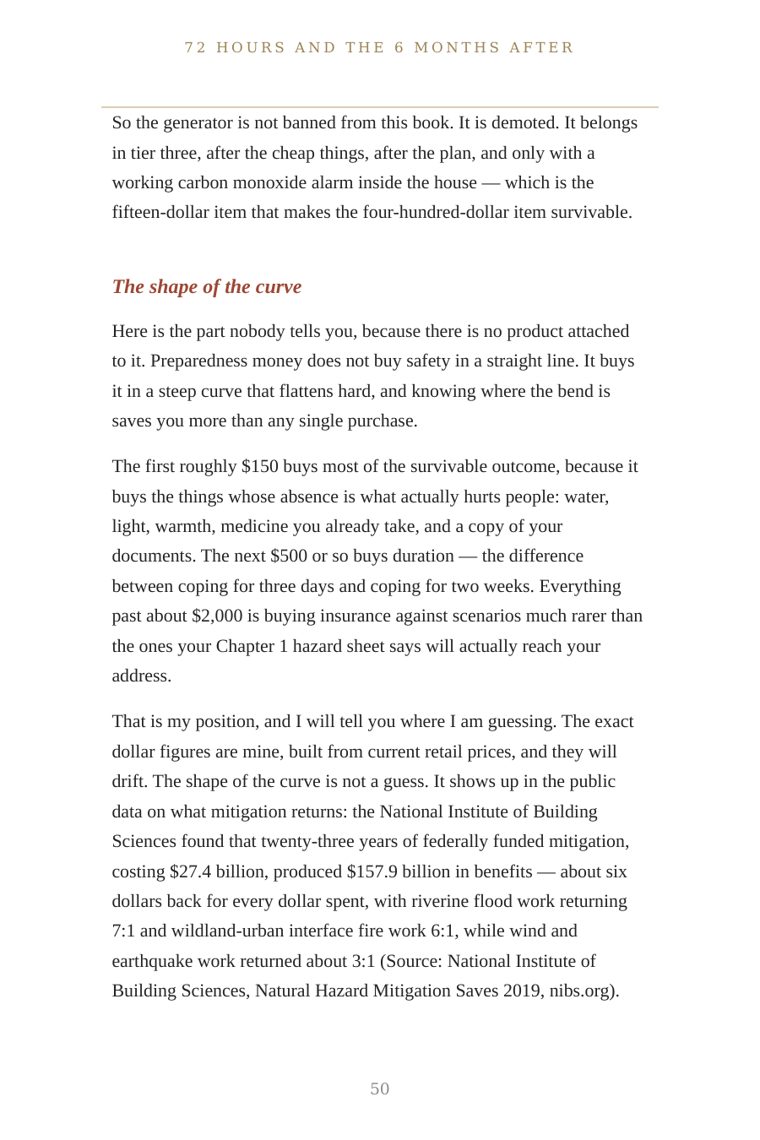
6 : 1Every dollar spent on hazard mitigation returns about six dollars in avoided loss — $27.4 billion spent, $157.9 billion avoided across 23 years of federally funded work.
The figureWhat it is
Median FEMA household award$1,000
Programme cap for housing assistance$43,600
Return on each dollar of mitigation, riverine flood7 : 1
Return on each dollar, wildland-urban interface fire6 : 1
US adults who could cover a $400 emergency in cash63%
What the first tier of preparation costsabout $150
What this manual costs today$27

Preparation is not insurance and it is not a stockpile. It is the set of decisions you make while nothing is happening, so that the worst ten minutes of your life do not also have to be the ten minutes you make them in.

Median and maximum award figures from the Government Accountability Office (GAO-25-106862) and the Federal Register notice of maximum assistance, 24 October 2024. Benefit-cost ratios from the National Institute of Building Sciences, Natural Hazard Mitigation Saves, 2019. Emergency-expense figure from the Federal Reserve, Economic Well-Being of U.S. Households in 2024. Tier costs are the author's, built from 2026 retail and named as estimates in the book. Every one of these appears in the manual with its source printed beside it.

Actual pages

This is what you get, page for page.

Five real pages from the file that lands in your inbox. Scroll sideways.

Nine sections · Forty-five chapters

What's inside

Ordered the way the work actually happens: know your risk, build the lifelines, pack the kits, then hazard by hazard, then the event, then the recovery.

Section One · 5 chapters

Know Your Ground

Find out which disasters can actually reach your address — and stop preparing for the wrong one.

  • Four free map layers that rank your real hazards in one afternoon
  • Seconds to five days: the warning you will actually get, hazard by hazard
  • The forty-minute house survey, room by room
  • The plan that fits on one page, and why local phone lines fail first

Section Two · 5 chapters

The Five Lifelines

Water, food, power, warmth, sanitation. Everything else is detail.

  • Why one gallon per person per day is the floor, not the answer
  • Fourteen days of food for a fraction of what a bucket costs
  • Power tier by tier — and where the money stops buying usefulness
  • The thirty-dollar sanitation kit nobody plans for and everybody needs

Section Three · 5 chapters

What You Carry, What You Keep

Three kits, not one — and the difference between them is the difference between leaving and staying.

  • Why three days of water weighs more than a whole pack allowance
  • The medical kit that matches your prescriptions, not a first-aid list
  • Documents, cash, and the copy that survives the house
  • Radio, FRS, GMRS and satellite — what a normal household actually needs

Section Four · 5 chapters

When the Ground Moves

Earthquakes: what actually kills people, and the sixty seconds you get.

  • Two countries, similar magnitudes, death tolls two orders of magnitude apart
  • Drop, cover, hold on — and the two myths that get people killed
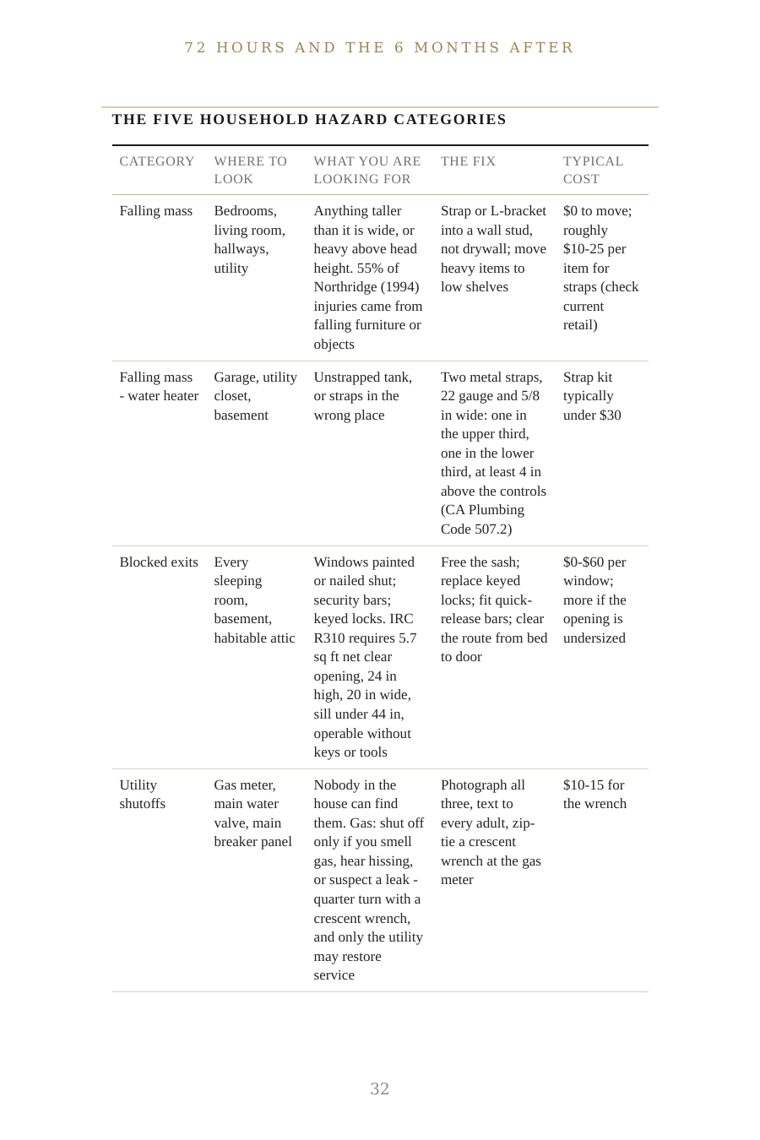
  • Two hundred dollars of straps and latches that saves a room
  • Reading your own building after the shaking stops

Section Five · 5 chapters

Water That Arrives

Floods and tsunamis — the most common disaster on earth, and the most underestimated.

  • Six inches moves a person. Twelve moves a car. Six deaths in ten are in vehicles.
  • Three different floods that need three opposite decisions
  • The flood exclusion in your policy, and the waiting period nobody reads
  • The tsunami you are warned about, and the one where the shaking is the warning

Section Six · 5 chapters

Wind

Hurricanes, typhoons and tornadoes: days of warning, or thirteen minutes.

  • Why the official warning arrives after your real decision deadline
  • The garage door is the weakest large opening on most houses
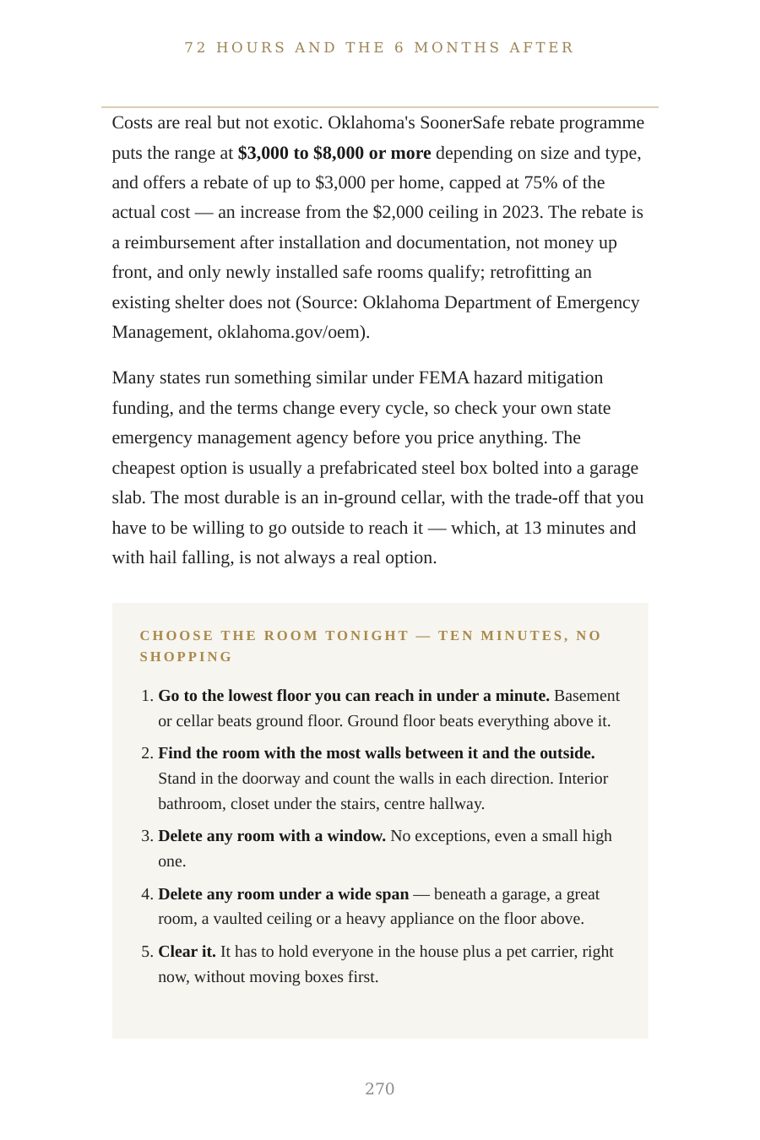
  • Thirteen minutes, and the interior room that will do
  • The week after, when more people are hurt than during the storm

Section Seven · 5 chapters

Fire and Ash

Volcanoes, wildfire, and the two extremes that kill more people than all of them.

  • Which volcanic hazard reaches you at 5km, 30km and 300km
  • Wet ash roughly doubles in weight — and roofs fail under it
  • The ember, not the flame: the first five feet decide the house
  • The hundred-dollar clean-air room, and the mask that does nothing for smoke

Section Eight · 5 chapters

The First Seventy-Two Hours

The universal protocol — whatever hit you.

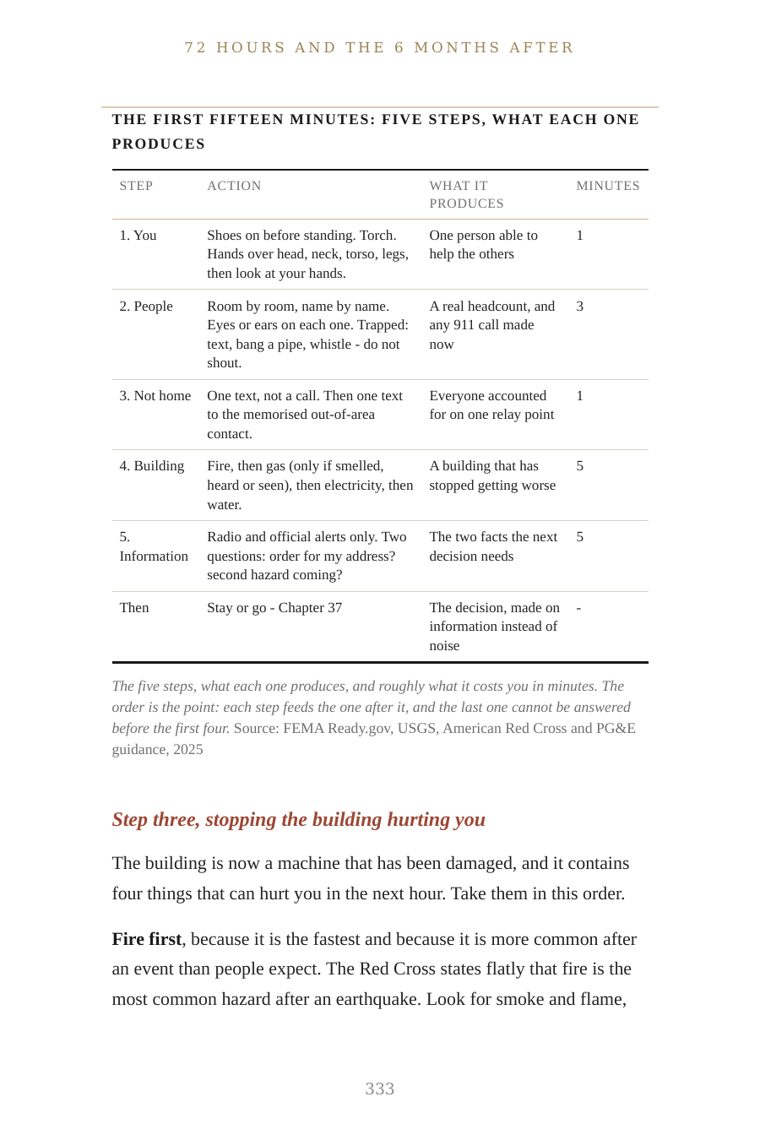
  • The first fifteen minutes, in order, for any event
  • Stay or go, decided by written criteria instead of nerve
  • The four things a civilian can actually do when help is delayed
  • Finding real information, and killing the rumour that is already moving

Section Nine · 5 chapters

After

Recovery is the longest phase and the one that costs the most.

  • Photograph, then cut: the evidence that decides whether the claim pays
  • Drying beats cleaning, and the ten square feet that needs a professional
  • What public assistance really covers, and the fraud that follows every disaster
  • Two weeks to two months, and the two-hour annual review that keeps it all true

Included with every copy

$106 value · yours free

Six printable documents, for the moments the book isn't in your hand.

The manual tells you what to do. These are what you carry, fill in, tick off and stick inside a cupboard door — designed to print in black and white on ordinary paper.

The main event

72 Hours and the 6 Months After

422 pages · 45 chapters · 45 photographs · 20 charts · 45 artifact boxes. Every hazard that can reach your address, the first seventy-two hours, and the six months that decide recovery.

The book itself$47

Free bonus no. 1

The Three-Kit Build Sheets

Go-bag, stay-box and car box on three tick-box sheets, with $150, $400 and $900 tiers priced line by line — so you can start at the bottom and stop wherever your budget does.

$19Free

Free bonus no. 2

The Grab-and-Go Document Pack

The checklist of what an adjuster and an assistance programme will ask for, plus a fill-in template for the copies that survive the house — and where each copy should live.

$19Free

Free bonus no. 3

The 72-Hour Action Cards

One stiff card per hazard. First fifteen minutes on the front, first three days on the back. Print them, cut them, and put them where the torch is.

$24Free

Free bonus no. 4

The Water and Food Rotation Log

A dated tracker for everything stored, so the supply you built in March is still good in three years instead of quietly expiring in a garage.

$15Free

Free bonus no. 5

The Medication and Medical Needs Sheet

Prescriptions, doses, prescribers, devices and power-dependent equipment for every person in the house — the single most useful piece of paper in an evacuation.

$15Free

Free bonus no. 6

The Radio and Comms Card

Your frequencies and alert channels written down in one place, what to set up before, and what to do during a blackout when the towers are up but the power is not.

$14Free

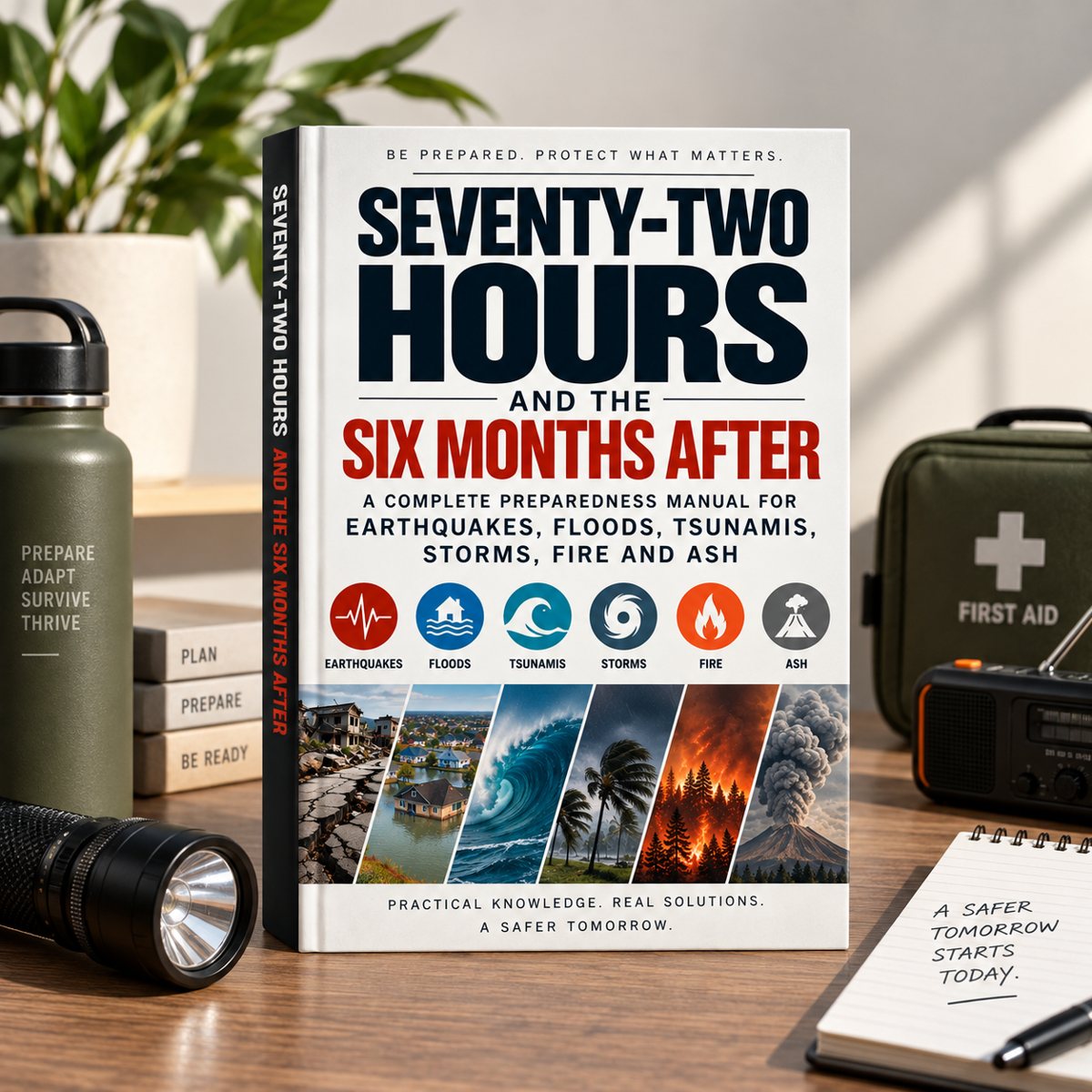
The manual on a desk beside a torch, a water bottle, a first aid kit and an emergency radio
$106 of companion documents, free.Six separate files, six different jobs — included with every copy.
Total value$153
Launch edition$27

Order

Illustrated PDF · 422 pages · 9 sections · 45 chapters · 6 companion documents

$153 of material. Pay $27.

The manual is $47. Right now it is $27 — and the six companion documents, $106 on their own, are included free with every copy.

Launch price ends in10hrs10min02sec

Before you buy

Questions

I live somewhere with only one real hazard. Is most of this wasted on me?
No, and Section One is what makes sure of it. You spend one afternoon producing a ranked list of the hazards that can reach your address, and the book then tells you which chapters are yours. Twenty of the forty-five apply to everybody regardless — risk, water, food, power, warmth, sanitation, kits, the first seventy-two hours and the recovery.
I'm not a prepper and I don't want to become one. Is this that?
It is the opposite of that. There is no bunker, no bulk freeze-dried anything, and no politics. The first tier of preparation in this book costs about $150 and fits in a cupboard. The book is explicit about where spending stops making sense, which is roughly the point where most of this industry starts selling.
How long does it take to get something real out of it?
One evening for Section One, which produces your hazard list. One weekend for the house survey and the one-page plan. After that it is a shopping list you work through at your own pace.
Is this American-only?
The figures, agencies and legal rules are American by default, because that is where the published data is. The methods travel — the hazards behave the same everywhere — and where a hazard is concentrated elsewhere, the international equivalents are named. The book says plainly which parts you need to check locally.
What format is it, and can I print it?
A PDF you can read on anything, plus six companion documents sized for US Letter and designed to print in black and white. No app, no account, no login.
Are the six companion documents really free?
Yes. They are priced at $106 as standalone documents and they come with every copy at no extra cost, in the same email as the manual.
$27 launch edition. $47 after that.

Launch price ends in10hrs10min02sec